OC Creator logoOC Creator
Free local comic character lab

Mutant Power Generator

Raise a force shield, bend gravity or step through a rift. This mutant power generator builds a comic-book ability with a punchy codename, an activation cue, an operating range, a real limit and a personal cost. Scan a complete profile, lock the parts that define your character, and send the finished file to the Marvel creator. Text rolls are free, local and require no sign-up.

  • 29 comic power families
  • Free local rolls, no sign-up
  • Locks, favorites and PNG dossiers

Field lab / mutation scan

Read your mutation file

Scan a comic power. Lock any field to keep it. Locking a codename, effect, range, limit or mutation also keeps its power family coherent.

Scan complete / profile ready100%

ORIGINAL MUTATION / COMIC FIELD NOTES / Energy projection

Arcbrace

Projects an amber force shield that can catch a falling motorcycle. Activation: tapping two fingertips together. Range: Projection reaches 15 meters. Limit: Only one construct can exist at a time.

Codename

Arcbrace

Effect

Projects an amber force shield that can catch a falling motorcycle

Operating range

Projection reaches 15 meters

Activation cue

tapping two fingertips together

Hard limit

Only one construct can exist at a time

Personal cost

needs a ten-minute quiet break afterward

Physical mutation

translucent angular ridges along the forearms

First manifestation

while catching debris at a damaged train platform

Fan scale, not Marvel canon

3 / Tactical: three controlled uses before recovery

How others see them

neighbors ask for everyday help

Nonlethal field protocol: shields, rescue, disarming and controlled restraint. No wounds, killing, crushing, suffocation or attacks on internal organs. Sustained effects last at most 20 seconds. Effects release or dissipate before causing injury; the stricter power limit or recovery cost always wins.

Draw this OC

Text rolls are free with no sign-up. Drawing opens the separate Marvel creator and does not generate an image automatically.

Saved profiles (0/20)

Stored on this browser only. The newest 20 are kept. Loading a profile clears locks.

Scale 1–5 measures controlled uses before recovery, not destructive power. Single-field rerolls stay within the current family; release all linked locks for a new family. It is a fan-made writing aid, not a Marvel classification or a measure of a person’s worth. See Marvel Database’s classification notes for the comic terminology.

Six original field files

Six mutants ready for the field

These original mutants have visible, scene-changing powers: an energy shield, an ice ramp, a gravity pocket, a teleportation gate, a living catch net and projected light decoys. Each illustrated file uses the same detailed comic treatment and a setting that explains what the ability does. Inspect one to load its complete rules, then reroll within its family or release the locks for a different power.

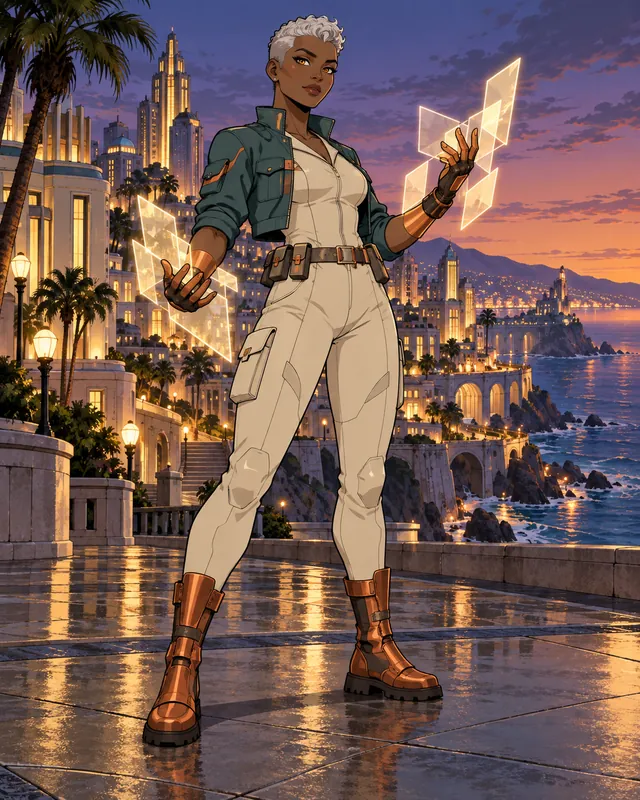
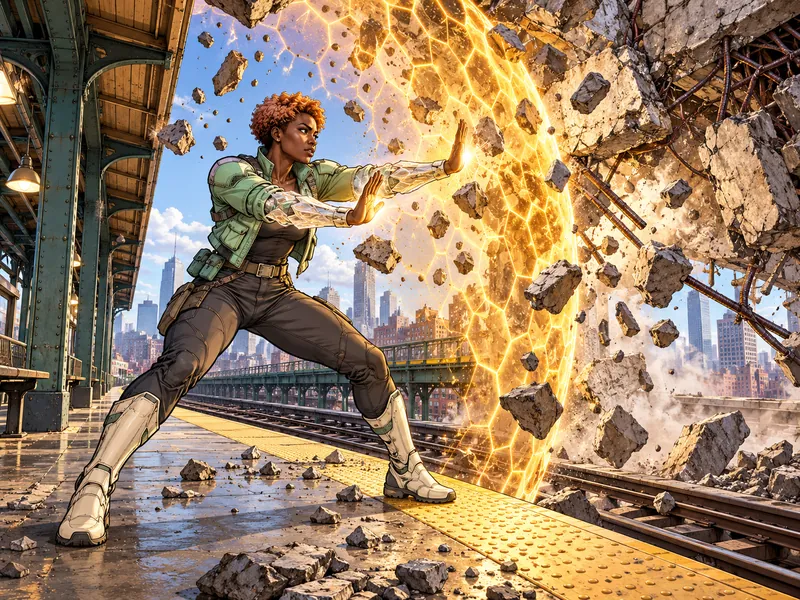
Arcbrace, an original mutant demonstrating Projects an amber force shield that can catch a falling motorcycle

Arcbrace

Projects an amber force shield that can catch a falling motorcycle. Activation: tapping two fingertips together. Range: Projection reaches 15 meters. Limit: Only one construct can exist at a time.

A rescue defender with copper coils, a mint armored field jacket and cream boots braces an amber force shield against falling masonry on an elevated train platform. The translucent ridges along her forearms echo the shield geometry without resembling a familiar team uniform. She can hold only one construct, so protecting the platform means she cannot also fire a disarming ring. Her ten-minute recovery break forces the team to plan a handoff rather than assume she can defend every angle indefinitely. The scene should show the weight and direction of the incoming debris, an open escape route and her planted stance. Keep the shield within its motorcycle-sized load ceiling; she is buying time for evacuation, not holding up an entire skyscraper.
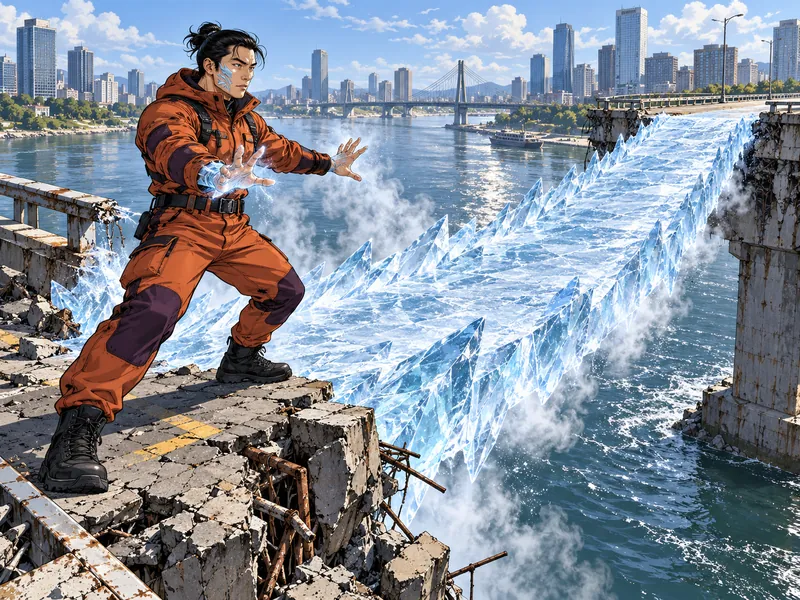
Rimebrace, an original mutant demonstrating Raises a thick ice ramp to carry people across a broken bridge

Rimebrace

Raises a thick ice ramp to carry people across a broken bridge. Activation: tracing a circle in the air. Range: Ice formation reaches 15 meters. Limit: Needs moisture and fails in completely dry air.

An ice-shaping rescuer in a rust-orange insulated field suit raises a broad crystalline ramp across a broken riverside bridge. His ordinary skin, tied-back dark hair and blue cheek ridges distinguish him from a full-body ice transformation. Moisture provides the material, and completely dry air stops the effect. The ramp gives teammates a route, but it does not turn every person or object nearby into ice. He needs a snack before repeating the effort, so an extended rescue requires supplies and another route if conditions change. Draw the ramp as a substantial structure with clear contact at each end rather than a decorative snowflake. The power feels large because it changes the geography of the scene, while the resource limit remains readable.

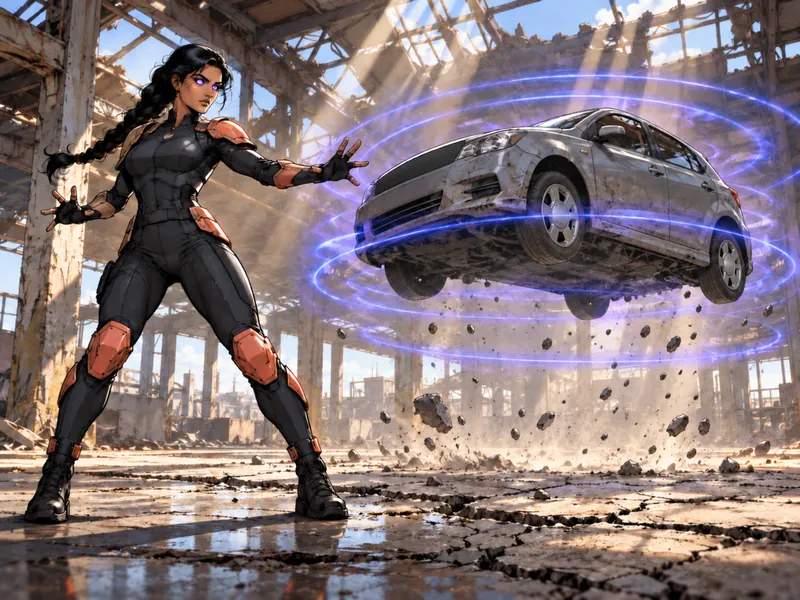
Graveloom, an original mutant demonstrating Creates a local low-gravity pocket that slows a falling vehicle

Graveloom

Creates a local low-gravity pocket that slows a falling vehicle. Activation: whistling a soft tune. Range: Gravity field centers can be placed within 15 meters. Limit: Only one gravity pocket can exist at once.

A gravity specialist with a long dark braid, a charcoal field suit and coral armor panels suspends a small empty vehicle above a fractured depot floor. Indigo rings in her eyes and circular distortions around the vehicle reveal the mutation. This is a local low-gravity pocket, not unlimited control over planets or everyone in the district. Only one pocket can exist, so moving the rescue zone means releasing the previous one safely. Afterward she briefly forgets a familiar tune, a small but noticeable sign of mental strain. The dramatic choice is where to place the field while teammates secure the vehicle. Keep the passengers outside the artwork so the single-character composition focuses on the visible power and the planned landing space.

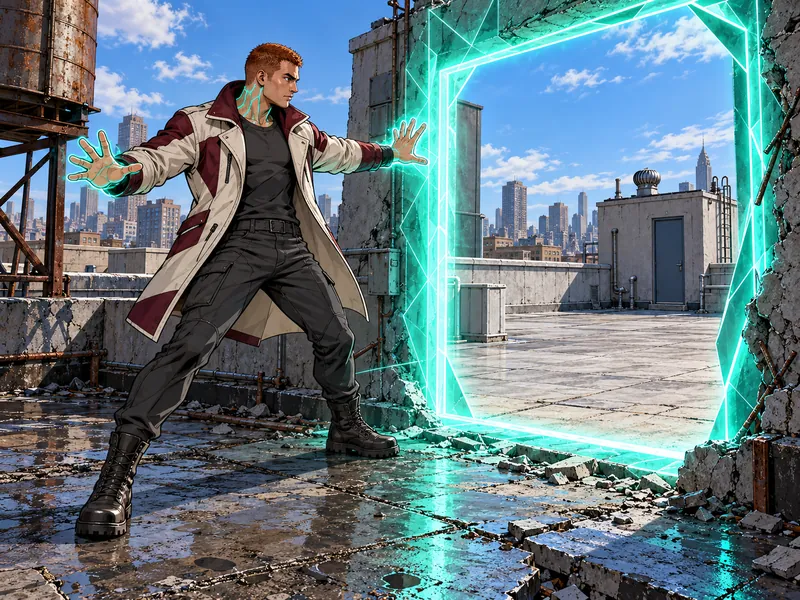
Riftspan, an original mutant demonstrating Opens a sharp-edged teal doorway to a visible unoccupied landing zone

Riftspan

Opens a sharp-edged teal doorway to a visible unoccupied landing zone. Activation: knocking twice on a table. Range: Maximum jump distance 15 meters. Limit: Destination must have clear space for a safe arrival.

A broad-shouldered mutant with an auburn buzz cut and a cream-and-burgundy field coat opens an angular teal doorway across a broken rooftop passage. Teal geometric seams along his neck match the doorway edges. Both the departure surface and empty destination are visible, making the range and safe-arrival rule legible. There is no smoke cloud, pointed tail, sword or borrowed team emblem. The jump is useful for evacuation, repositioning and reaching a stranded teammate, but it cannot bypass a sealed wall when the landing zone is unknown. He feels as tired as after a brisk walk once the sequence ends. Give him a route to inspect and a reason to choose carefully rather than treating teleportation as permission to appear anywhere.

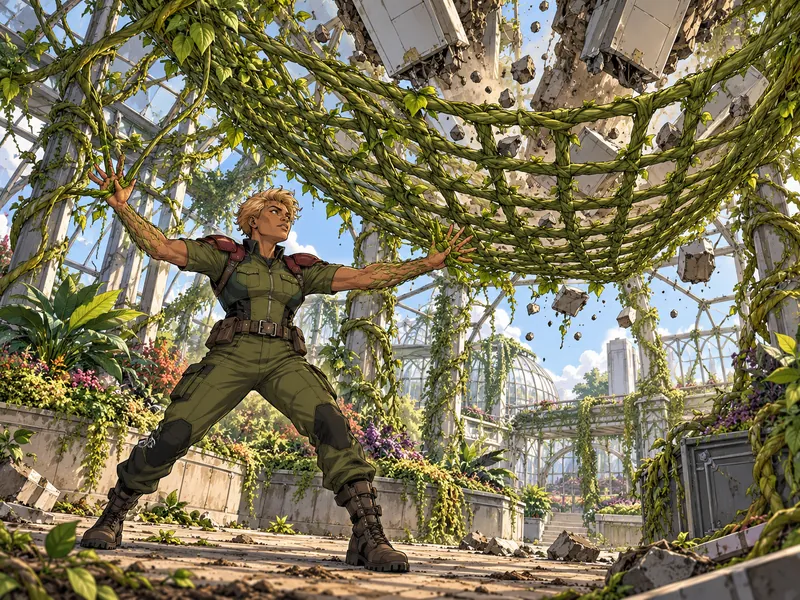
Briarweft, an original mutant demonstrating Raises existing vines into a broad living net that catches falling debris

Briarweft

Raises existing vines into a broad living net that catches falling debris. Activation: touching thumb to little finger. Range: Plant influence reaches 15 meters. Limit: Needs living plants already present.

A plant controller with sandy hair, a moss-green field suit and burgundy shoulder guards raises existing vines into a broad catch net beneath falling construction panels. Leaflike ridges on their forearms connect the body mutation to the power. The setting is a damaged greenhouse courtyard where living plants are already present, not bare concrete suddenly producing unlimited forest. The net spreads the load and releases safely once teammates secure the panels. They cannot keep time with music afterward, so their training partner uses spoken timing cues during recovery. The scene can be bold and tactical without making plants cruel or sharp. Avoid thorn projectiles, trapping someone’s breathing space or copying another character’s leaf-covered costume.

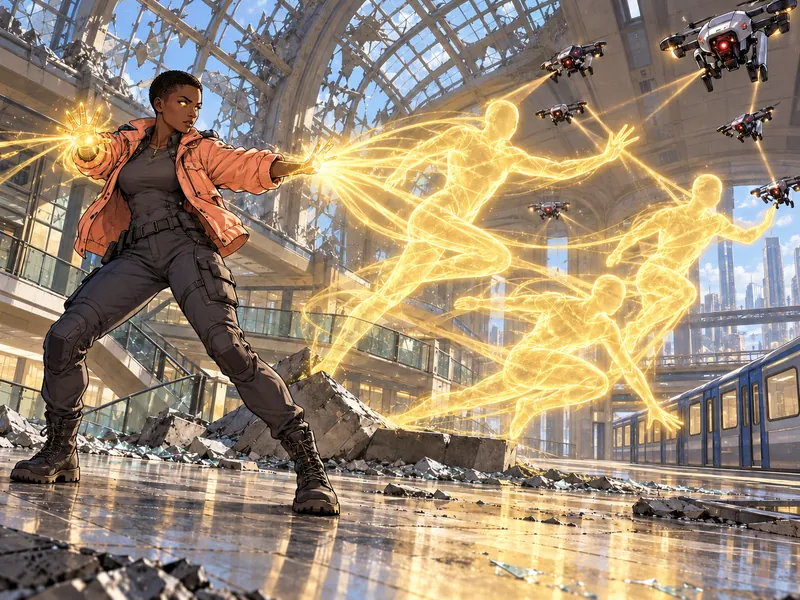
Luxbrace, an original mutant demonstrating Bends light into three moving decoys that draw attacks away from civilians

Luxbrace

Bends light into three moving decoys that draw attacks away from civilians. Activation: tapping a heel twice. Range: Light shaping reaches 15 meters. Limit: Cannot give illusions physical force.

A light shaper with close-cropped black hair, a peach-and-charcoal field suit and gold-faceted irises projects three bright decoys across a damaged station concourse. Only one real person appears; the decoys are clearly translucent faceless light silhouettes in different positions. They draw automated targeting away from an evacuation route without touching or controlling anyone’s mind. The illusions cannot exert force, so a teammate still has to move the physical obstruction. The user must sit down for a short rest afterward. The illustration should make the distinction between solid figure and projected light obvious through edges, transparency and shadows. This is a tactical misdirection power with a practical limit, not a promise of invisibility, solid holograms and energy weapons all at once.

Power families

Find your comic power family

The scanner contains 29 families, grouped here by how they change a scene. These are writing categories, not official Marvel classifications. Each roll stays inside one family so its effect, codename, range, hard limit and visible mutation make sense together.

Energy and elemental control

Force shields, controlled knockback blasts and elemental barriers can define the action in a scene. The bank includes fire, ice, water, earth, air and lightning as separate families rather than giving every character an entire weather system. Each has an appropriate resource or targeting restriction: fire may require an existing flame, water cannot be drawn from a body, and electrical effects need grounding. Start with one visual language and one tactical role. A defender who must choose between shielding and firing has a decision to make even before the opponent acts. Nonlethal does not mean powerless; it means the action is framed around rescue, disarming and safe restraint.

  • Force projection
  • Six elemental families
  • Resources and counters

Gravity, density and telekinesis

These abilities change how bodies and objects move, but they do so through different rules. Gravity establishes a local field, density changes the user’s own physical state, and telekinesis applies a visible grip to an external object. The file keeps those families separate so a strength limit does not become accidental telepathy or unlimited matter control. Metal sensing is another distinct family: it reveals stress and trajectories without granting the ability to command all metal. Describe the center of the field, the maximum load and the safe release. A floating car or a wall-running route can be dramatic while remaining much narrower than a famous mutant’s complete power set.

  • Local fields
  • Visible load limits
  • No organ targeting

Light, darkness and sound

These families control visibility, perception and pressure in different ways. Light decoys can distract but cannot physically catch a person. A shadow curtain can conceal a route, yet it also blocks the user’s view. Sound can map a room or create a controlled pressure shield without becoming an attack on someone’s hearing. Give the effect a shape the reader can recognize: a ribbon, a curtain, concentric rings or a translucent silhouette. Then show the counter, such as acoustic foam or a bright light breaking up a shadow. The resulting power belongs in an action scene without needing every sensory trick to work at once.

  • Decoys and concealment
  • Pressure shields
  • Readable counters

Mobility and transformed bodies

Teleportation, flight, super speed, phasing and size change each create a different kind of movement problem. A teleporting character needs a clear landing zone; a speedster needs a route and braking room; a phased character cannot breathe or manipulate solid objects while inside a barrier. Adaptive animal traits add climbing, gliding or short underwater access without copying another person’s identity. Strength and durability offer an alternative: stay in place and hold the obstacle while the team moves. These files use field outfits and visible mutations rather than famous silhouettes. A new tail, visor or claw set should never be added merely because it seems familiar.

  • Routes and landing zones
  • Body-specific rules
  • Distinct silhouettes

Mind, machines and perception

Limited telepathy and empathy can connect willing teammates or read broad emotional pressure, without commands, stolen memories or forced loyalty. Technopathy connects to local machines but does not invent passwords, expose private data or reach every computer in a city. Time perception changes the user’s experience of a moment; it does not stop the outside world or predict someone’s choices. These distinctions matter because a vague mental power can otherwise solve every problem offscreen. Give the character a specific information channel, a range and a reason they need another teammate. A visible circuit map or colored emotional ring can make an abstract ability useful to draw.

  • Consent-based links
  • Local device access
  • No universal foresight

Living systems and unusual advantages

Healing others, duplication, plant control, animal rapport and probability create powerful support roles. Healing has a ceiling and never replaces ordinary care; duplicates share attention and fatigue; plants need living material; animals can refuse a request. Probability selects among plausible outcomes rather than making the impossible happen. These limits leave plenty of room for a catch net, a coordinated rescue carry or a critical latch releasing at the right moment. Do not confuse a support role with a weak role. Ask what the rest of the team could not accomplish without this character, then make the cost visible when they choose to help again.

  • Healing and duplication
  • Living networks
  • Plausible probability

Guide

Turn a power into a character

A strong comic power has a recognizable effect, a boundary and a person making choices inside it. Use these steps to keep an exciting result consistent across drawings, roleplay scenes and a longer story. You can revise individual parts without losing a promising character.

  1. 1

    Read the power before the rank

    Start with the actual action: what does the character project, move, sense or become? Then check the operating range and the physical ceiling described in the effect. A shield that can catch a motorcycle does not automatically support a building because the fan scale reads five. The scale measures controlled uses before recovery, not destruction. Think of a short scene in which the ability matters, such as catching a falling load or crossing a damaged passage. The initial file is already filled so you can inspect a complete example before the first scan.

  2. 2

    Keep the family coherent while editing

    Each field has a lock and an individual reroll. Single-field rerolls stay within the current power family, preserving compatibility with the other details. Locking a codename, effect, range, limit or physical mutation also anchors that family during a full scan. To explore a completely different family, release those linked locks first. This prevents a teleportation file from inheriting an ice-only restriction. You can still lock a personal cost, first manifestation or social reaction while searching across families, because those story details work independently of the specific mechanism.

  3. 3

    Give the power a visible counter

    A good limit creates a choice the reader can understand. One construct at a time means shielding and attacking compete. A visible destination means a sealed wall can stop teleportation. A local machine connection means a technopath must reach the equipment first. Keep those constraints in the scene rather than treating them as flavor text. Add the personal cost afterward: recovery time, tired muscles or reduced concentration should change the next decision. The stricter limit or cost overrides the fan-scale ceiling, so a character never gains a free exception just by rolling a higher number.

  4. 4

    Design the person around one clear effect

    Use the physical mutation as a design anchor, then choose a field outfit with a distinct silhouette and practical protection. A translucent forearm ridge can echo a force shield; geometric neck seams can echo an angular portal. Avoid assembling a famous character from separately familiar pieces, such as claws plus healing, a white-haired weather user or a teleporting figure with smoke and a tail. Give the character an ordinary goal and a team relationship too. Their first manifestation may be dramatic, but their whole personality should not be a description of their power.

  5. 5

    Test a rescue and a confrontation

    Write two short situations using the same rules. In the rescue, identify what must be caught, moved, reached or stabilized. In the confrontation, consider shields, controlled knockback, disarming, concealment or restraint. Neither scene needs injury or killing to feel urgent. The shared nonlethal protocol prevents crushing, suffocation and attacks on internal organs, and effects release before causing harm. This does not erase the ability’s impact: a blocked route, lost weapon or well-timed decoy can decide an encounter. The challenge is using the established power creatively without adding a second unrelated gift.

  6. 6

    Save the file and prepare the drawing

    Favorites store up to twenty complete files in this browser. Copy a profile or export its PNG dossier before clearing site data or switching devices. Draw this OC opens the Marvel creator with the mutant origin, codename, compact power field and full rule text prepared. The full description carries the range, limit, cost and visible mutation even if the short power field is truncated. Anime mode changes the presentation and drawing style; it does not turn the result into an official Quirk or Stand. Opening the creator does not generate an image automatically or spend credits.

FAQ

Mutant power generator questions

Juniper Vale, an original original anime characterKaito Arashi, an original anime characterSorrel the Fennec, an original Sonic the Hedgehog characterStarlit Quill, an original My Little Pony: Friendship is Magic characterRei Kagami, an original My Hero Academia characterFlarepaw, an original Warrior Cats characterTinsel the Raccoon, an original Five Nights at Freddy's character

Your next OC is one sentence away

Sign up for 10 bonus credits and make your first OC free.