OC Creator logoOC Creator
Free local JJBA stand generator

JoJo Stand Creator

Make a strange ability feel like a real character. This jojo stand maker pairs an original music-flavored name with a user, a visual concept, clear rules and a counter. Drag the six-point stat chart into shape, keep the parts you like, and export your own Stand card. Every text roll runs in your browser, free with no sign-up.

  • Free text rolls, no sign-up
  • Editable hexagon stat chart
  • Locks, favorites and PNG cards

STAND LAB / LOCAL GENERATOR

Press play on a new Stand

Original mint and burgundy accordion-armored Stand with its fashionably dressed user at a station

Original music-flavored names. Choose a style, then roll.

Your first Stand is ready. Make it yours.

nameBrass on the Run
Stand userMaren Vellari
typeClose-range
abilityMomentum Gate: Palm Rule
statsA / A / E / B / B / C
looka tall angular humanoid, made of matte ceramic in saffron and ink-black, with trumpet-bell and valve shoulders, an elongated ivory trapezoid mask with an amber horizontal slit, diagonal black markings and a cobalt tuning-fork pendant.

Locks protect rolls and grade edits. A type change keeps locked stats; review the range grade when mixing parts.

Edit user & setting

Keep your favorites 0/24

Saved on this browser. Copy or export a card for a lasting backup.

A strange little ability worth keeping? Save it below the card.

    ORIGINAL STAND / JAZZ

    Brass on the Run

    Close-range

    POWERASPEEDARANGEEPERSISTENCEBPRECISIONBPOTENTIALCEDCBA
    Drag along any spoke, or choose a grade below.
    Destructive PowerA
    SpeedA
    RangeE
    PersistenceB
    PrecisionB
    Development PotentialC

    STAND USER

    Maren Vellari, 24

    Morioh town (Part 4). collects misprinted tickets.

    APPEARANCE / HUMANOID OR CREATURE

    a tall angular humanoid, made of matte ceramic in saffron and ink-black, with trumpet-bell and valve shoulders, an elongated ivory trapezoid mask with an amber horizontal slit, diagonal black markings and a cobalt tuning-fork pendant.

    Momentum Gate: Palm Rule

    Builds a transparent pressure plane that redirects rolling or sliding loose objects onto a chosen safe route without adding speed.

    Trigger: To activate, the user touches the boundary twice with an open palm. Every trigger leaves a movable enamel marker at the zone center and a visible, erasable boundary.

    Rules: Up to 1 nonliving target, each no larger than 3 meters across, inside a 2-meter-radius zone. The effect lasts 30 seconds; targets outside the zone are released.

    User cost: The user must keep one hand open; closing it ends the effect.

    Reach & control: The manifestation stays within 2 meters of its user. The selected zone must touch that reach.

    Counterplay: Cover the activation point with opaque cloth to end the effect.

    Only nonliving props and safe surface patches are affected, never bodies, occupied vehicles or load-bearing structures. Force yields before injury and every barrier leaves breathable space and an exit; no gore.

    Fan-made concept • A–E grades are story notes • occreator.org

    Stand stats maker

    E is lowest, A is highest. Persistence is also called Stamina or Durability; Potential means room to develop.

    Destructive Power
    Speed
    Range
    Persistence
    Precision
    Development Potential

    Text rolls and PNG cards are free, no sign-up. Draw this Stand opens the JoJo OC creator with your description filled in. Image generation has its own preview and credit rules.

    THE TEST PRESSINGS

    Six Stands. Six ways to win a scene.

    A memorable jojo stand oc does not need to overpower the whole cast. Start with a small rule, then find the situation where that rule matters. Load any of these original concepts into the lab, change its grades, or lock its ability while searching for a different name and user. The charts are editable once loaded.

    01 / CLOSE-RANGE

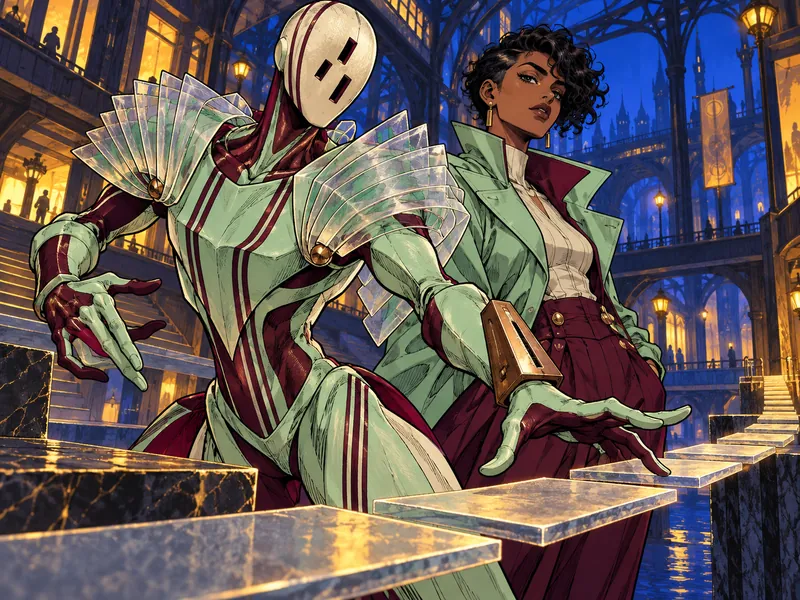
    Brass on the Run

    Brass on the Run: a tall angular humanoid, made of matte ceramic in saffron and ink-black, with trumpet-bell and valve shoulders, an elongated ivory trapezoid mask with an amber horizontal slit, diagonal black markings and a cobalt tuning-fork pendant. User Maren Vellari stands behind it.
    POWERASPEEDARANGEEPERSISTENCEBPRECISIONBPOTENTIALCEDCBA

    Momentum Gate: Palm Rule

    a tall angular humanoid, made of matte ceramic in saffron and ink-black, with trumpet-bell and valve shoulders, an elongated ivory trapezoid mask with an amber horizontal slit, diagonal black markings and a cobalt tuning-fork pendant.

    Builds a transparent pressure plane that redirects rolling or sliding loose objects onto a chosen safe route without adding speed.

    Maren redirects a runaway luggage cart into an empty side platform, forming a barricade between a courier and a pursuer. The plane cannot add speed, so she needs existing motion and a safe destination. Her open palm is a visible weakness: occupying that hand breaks her concentration. A rival can cover the activation marker instead of challenging her strong, fast manifestation directly. The saffron ceramic body, trumpet shoulders and tuning-fork pendant match the illustration; her cream cropped jacket and cobalt top distinguish the user behind it.

    Counter: Cover the activation point with opaque cloth to end the effect.
    02 / LONG-DISTANCE

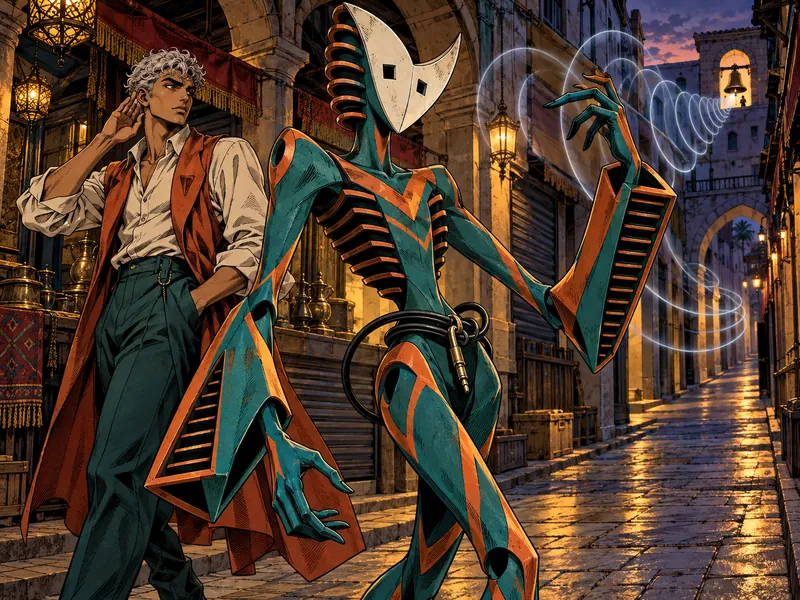
    Velvet Detour

    Velvet Detour: a slender humanoid with rectangular flared forearms, made of lacquered panels in teal and burnt orange, with speaker-rib torso panels, an asymmetric ivory crescent mask with square black eye apertures, orange chevrons and an audio-cable belt. User Ivo Bellmere stands behind it.
    POWERDSPEEDBRANGEAPERSISTENCEBPRECISIONCPOTENTIALBEDCBA

    Sound Detour: Chalk Rule

    a slender humanoid with rectangular flared forearms, made of lacquered panels in teal and burnt orange, with speaker-rib torso panels, an asymmetric ivory crescent mask with square black eye apertures, orange chevrons and an audio-cable belt.

    Routes sound emitted by selected objects along a visible corridor to a different edge of the zone, leaving the original route quiet.

    Ivo routes the rattle of a delivery trolley toward the far end of an alley, drawing attention away from a hidden doorway. Sound has a visible corridor and a definite exit, so a careful observer can follow the deception back to its source. His remote manifestation travels much farther than the local effect reaches. Lower Power and Precision leave room for mistakes when several objects make noise together. In the illustration, Ivo wears a rust waistcoat and teal trousers behind the lacquered Stand, whose cable belt and speaker ribs give its musical theme a physical shape.

    Counter: Move a target outside the marked zone to release it.

    03 / AUTOMATIC

    Applause for Nobody

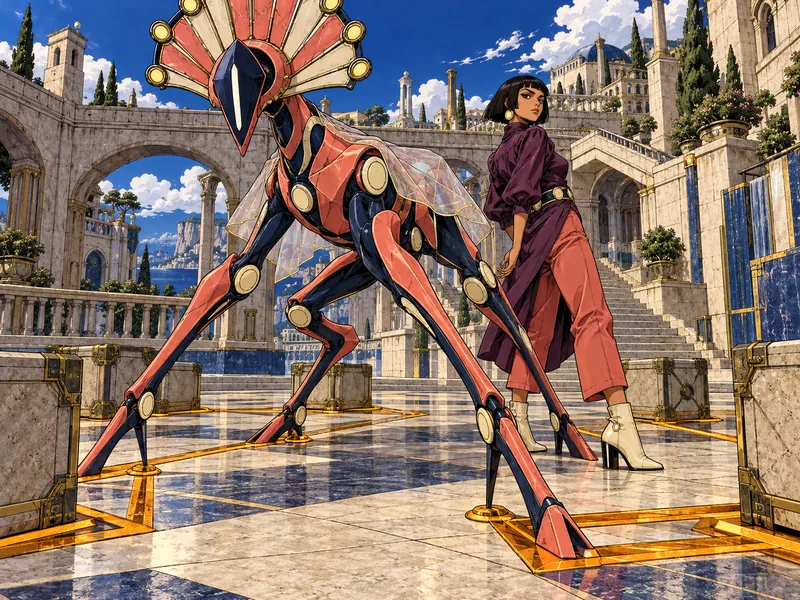
    Applause for Nobody: a long four-limbed crane-like creature, made of painted mechanical plates in coral and navy, with broad fan-shaped stage-light crest, a pentagonal navy faceplate with a cream vertical slit, cream round joints and a transparent shoulder cape. User Tessa Brisca stands behind it.
    POWERASPEEDBRANGEBPERSISTENCEAPRECISIONEPOTENTIALCEDCBA

    Friction Cage: Twin Coin Rule

    a long four-limbed crane-like creature, made of painted mechanical plates in coral and navy, with broad fan-shaped stage-light crest, a pentagonal navy faceplate with a cream vertical slit, cream round joints and a transparent shoulder cape.

    Raises friction on selected floor patches until loose objects stop sliding and a pursuer must lift each foot deliberately to advance.

    Tessa prepares a friction lane across the courtyard and lets the automatic creature wait for its chosen trigger. Sliding crates stop, while anyone following must lift each foot deliberately rather than charge through. The power never glues someone permanently to the floor. A decoy can satisfy its instructions because Tessa must recall it to change them. High Power and Persistence describe a reliable obstacle; low Precision describes its literal response. Her plum tunic and coral trousers echo the long-legged creature without copying its pentagonal face or stage-light crest.

    Counter: Break the visible boundary mark with a dry cloth to end the effect.

    04 / MATERIALIZED (BOUND)

    Archive of Thunder

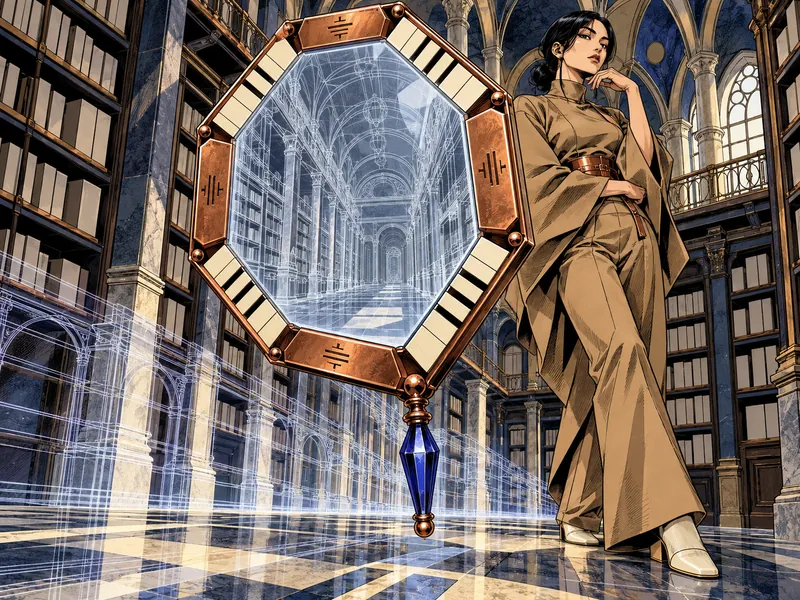
    Archive of Thunder: an octagonal hand mirror in copper and cream, made of polished copper and glass, with ivory piano-key rim segments, parallel etched markings and a cobalt glass handle. It has no body or face. User Neri Avenholt stands behind it.
    POWERESPEEDDRANGEEPERSISTENCEAPRECISIONAPOTENTIALBEDCBA

    Place Archive: Password Rule

    an octagonal hand mirror in copper and cream, made of polished copper and glass, with ivory piano-key rim segments, parallel etched markings and a cobalt glass handle. It has no body or face.

    Projects a walk-through visual reconstruction of the selected empty space as the user last observed it, revealing moved props but never reconstructing people or private thoughts.

    Neri holds an octagonal mirror toward the archive and projects the room as he last observed it. A missing cabinet becomes obvious when the present room fails to align with the transparent reconstruction. This is a fallible memory of a place, not a recording of people or an invitation to read thoughts. Covering the mirror disables the bound manifestation. The illustration shows the copper frame, ivory piano-key rim and cobalt glass handle exactly, with Neri in a tan high-neck suit behind the prop. Persistence supports investigation while Precision helps compare positions.

    Counter: Place a freestanding screen between the user and the zone to interrupt it.

    05 / MULTI-UNIT (COLONY)

    Static & Silk

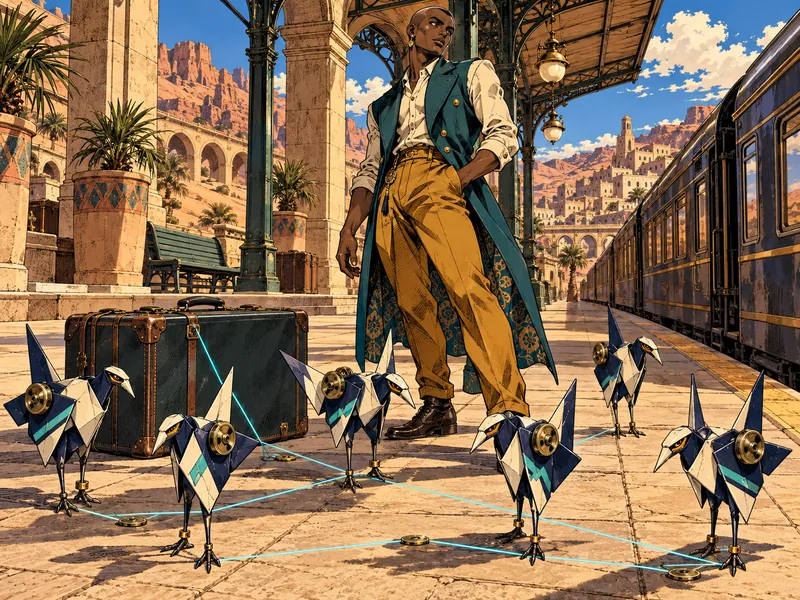
    Static & Silk: Six miniature units, each an origami crane-like bird machine, made of folded mechanical panels in navy and ivory, with tape-reel shoulder discs, an angular diamond face with amber slits, cyan diagonals and brass anklets. User Elian Corvelli stands behind it.
    POWERDSPEEDBRANGEBPERSISTENCEAPRECISIONBPOTENTIALCEDCBA

    Distance Tether: Backbeat Rule

    Six miniature units, each an origami crane-like bird machine, made of folded mechanical panels in navy and ivory, with tape-reel shoulder discs, an angular diamond face with amber slits, cyan diagonals and brass anklets.

    Links selected loose objects with rigid light guides so they keep their current separation while being moved together, making a portable barricade.

    Elian sends six miniature bird machines around loose station equipment and links selected props at their current separation. Moving one linked prop brings the others along, allowing a portable barricade to shift as a group. The guides do not cut, pull people or create extra targets. All six units share the same count and cost. An observer can interrupt the central marker rather than catch every unit. The navy and ivory origami bodies, tape-reel discs and brass anklets match the picture; Elian stands behind them in a teal long vest and ochre trousers.

    Counter: Push the activation marker one handspan aside to reset the zone.

    06 / PHENOMENON

    Glass After Midnight

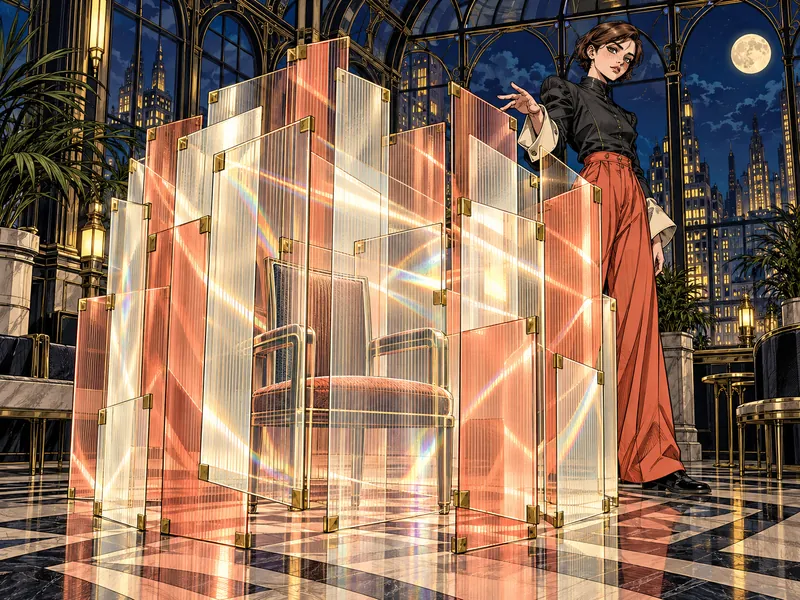
    Glass After Midnight: A bodyless field of transparent rectangular glass panels in coral and ivory, with transparent glass surfaces, refracted stage-light bands, fine graphite parallel lines and small brass corner clips repeated as small details. No separate creature or face. User Vera Dalmont stands behind it.
    POWERESPEEDDRANGECPERSISTENCEBPRECISIONBPOTENTIALAEDCBA

    Light Fold: Knuckle Rule

    A bodyless field of transparent rectangular glass panels in coral and ivory, with transparent glass surfaces, refracted stage-light bands, fine graphite parallel lines and small brass corner clips repeated as small details. No separate creature or face.

    Bends light around selected nonliving props so they blend into the background from one chosen direction, while their outlines remain visible from the sides.

    Vera bends light around a chair from one chosen direction, concealing a prop without removing it from the room. Side views still reveal its outline, so changing position is more useful than guessing where the chair went. There is no separate body to command or strike. The illustrated field consists of coral and ivory glass panels with graphite lines and brass corner clips in a nighttime conservatory. Vera wears a charcoal high-neck jacket with ivory cuffs and coral pleated trousers. A low physical Power grade keeps the emphasis on sightlines and misdirection.

    Counter: Strike a loud sustained note beside the boundary to collapse the effect.

    Convention references: Stand parameters, Stand types, and the canon name list. These examples are original fan concepts.

    Stand types

    Choose how your Stand reaches the scene

    JoJo classifications describe different things. Close-range, long-distance and automatic concern operation; phenomenon concerns form; materialized and multi-unit describe other properties. The six lab presets are convenient starting points, not six mutually exclusive canon categories. Their distances and limits are original design choices for this generator. Use the type to decide who controls the action, where the user must stand, and what a rival can interrupt.

    Close-range

    Keep the manifestation near its user and make the surrounding space matter. Our preset stays within two meters, so a crowded counter, narrow stairwell or locked gate can change the whole encounter. The ability has its own marked local zone, which must touch that reach. Imagine a character who needs to reach a receipt behind a shop window without attracting attention. Their problem is access, not the size of their power. Before increasing a grade, add a useful prop, a difficult route and a reason the user cannot simply walk straight to the target.

    • Near the user
    • Direct commands
    • Access matters

    Long-distance

    Separate the user’s safe position from the place where the Stand acts. In this preset the manifestation can travel fifty meters, but its ability still works only near itself. A Stand inspecting a balcony cannot also watch the street behind its user. That creates a choice: continue the investigation or recall it when something feels wrong. Write a scene with two locations and a visible travel route. Do not treat a high Range grade as permission to hear every conversation across town. Decide what information the user actually receives and what remains uncertain.

    • Remote operation
    • Local effect area
    • User left exposed

    Automatic

    Give the Stand one instruction that an opponent can discover. The lab’s automatic preset follows a target and trigger chosen in advance, rather than taking new directions every moment. It might watch for a colored object or repeat a sound after a drawer closes. The clever part is the mistake it can make: a decoy satisfies the same rule as the intended target. Write that mistake before writing the victory. When you reroll an ability, decide how its trigger becomes the preset instruction, and keep the user from correcting it without recalling the Stand.

    • Preset instruction
    • Literal trigger
    • Decoys work

    Materialized, or bound

    Anchor the effect to an ordinary object and let that object shape the encounter. This lab selects an ordinary anchor from its object bank, so every roll has an obvious physical weakness. The anchor gains the selected material and musical details; humanoid and creature silhouettes are reserved for other types. A small anchor can be hidden in a bag, placed beside a clue, or covered to disable it. Write down who currently holds it. Passing an object between characters is often a more interesting problem than adding a second power, especially when the holder does not know what it does.

    • Object anchor
    • Visible prop
    • Cover it to interrupt

    Multi-unit, or colony

    Use several small units to divide attention across a space. Our six units share one ability and its original target limit, so a one-object effect remains a one-object effect. Their spread helps with positioning rather than multiplying every action for free. Sketch where each unit goes and what happens when a doorway separates them. For a mystery, let one unit draw attention while another approaches a clue. For a friendly challenge, make the user count them before leaving. The unit count, shared limit and travel boundary should all stay understandable without a paragraph of exceptions.

    • Six small units
    • One shared power
    • Positioning puzzle

    Phenomenon

    Try a Stand that appears as a patterned effect instead of a separate creature. In our preset, the field stays with the user and stops when they leave the area. That makes presence itself part of the clue: someone might notice the strange patterns disappear as the user walks away. The look bank supplies colors and surface-like patterns, not armor or a face. When drawing this concept, describe the affected space clearly. A bodyless Stand can still have a strong visual identity through repeated shapes, a restricted palette and a consistent way of entering the scene.

    • No independent body
    • Patterned field
    • Ends on departure

    Guide

    Build a Stand that can carry a story

    Use this stand oc creator as a sketchbook. A roll gives you a complete first draft, but your choices make it memorable. The best test is a short encounter: one user wants something, one obstacle blocks them, and one understandable rule changes the outcome. Follow these six steps before taking the design into a longer fan story or a tabletop session.

    1. 1

      1. Find the name’s rhythm

      Choose a music style and roll until the words suggest a mood. Classic rock leans on instrument and performance language; jazz uses rhythm and ensemble terms; classical offers forms such as a prelude or concerto. These are invented combinations, not a catalog of real releases. Say the name out loud as if a character had to announce it during a tense scene. If it feels too elaborate, keep the image it suggests and use a shorter nickname in your own writing. Lock the name before exploring other parts so you can compare several designs under the same title.

    2. 2

      2. Give the user a reason to need it

      Read the user’s small habit before deciding their role in the plot. Someone who repairs umbrellas might notice rain damage; someone who returns borrowed objects early might worry about a missing book. Open the user editor to change the name, age or setting. The preset settings are story backdrops, not a claim that this original character appears in the manga. Keep one personal objective separate from the ability. A Stand that points toward a spool does not explain why its user needs that spool, who owns it, or why asking politely will not solve the problem.

    3. 3

      3. Test the rule and its counter

      Read the effect, limit and counter together. They are generated as a complete set so that the weakness actually interrupts the action. Place the power in a simple scene with three props, such as a receipt, a cup and a closed door. Ask what the Stand can do in one attempt, what it cannot do, and what another person would notice. Then let the opponent try the listed counter. If that ends the encounter too easily, change the situation before removing the weakness. A useful limitation creates choices for both sides and makes a later success feel earned.

    4. 4

      4. Shape the hexagon by hand

      The jojo stand stats maker lets you drag near any spoke to change its grade. For exact control, choose E, D, C, B or A in the six labeled rows. Moving toward the outer edge raises that stat. Start with the ability’s needs: a delicate clue might deserve Precision, while a fast distraction might deserve Speed. Persistence describes how long the effect can stay active; it is not a universal armor score. Development Potential describes room to learn. Lock stats when the shape feels right, then reroll other parts and check that the new type still suits the grades.

    5. 5

      5. Make the look easy to recognize

      Use a silhouette, a material detail and two colors before adding decoration. This generator favors unusual object forms so the results stay away from familiar muscular humanoid designs. A folding compass with ceramic fins reads differently from a walking concertina with enamel tiles, even in a small sketch. For a bound Stand, put the details on its mirror. For a phenomenon, turn them into repeating patterns in the affected space. Avoid official insignia and recognizable character costumes. The look should help a reader spot the Stand returning to a scene without needing to read its name again.

    6. 6

      6. Keep a draft, then draw the right subject

      Save a favorite to compare versions in this browser, copy the text into your notes, or download a PNG card with the chart and rules included. Favorites are local, so clearing browser storage removes them. Draw this Stand sends the current visual description and name to the anime OC creator. It does not start image generation or spend credits automatically. Review the filled description there before requesting an image, especially for a bodyless phenomenon or an object-bound form. The free local writing tool and the image service have different rules; the image page explains its preview queue and paid options.

    FAQ

    JoJo Stand creator questions

    Juniper Vale, an original original anime characterKaito Arashi, an original anime characterSorrel the Fennec, an original Sonic the Hedgehog characterStarlit Quill, an original My Little Pony: Friendship is Magic characterRei Kagami, an original My Hero Academia characterFlarepaw, an original Warrior Cats characterTinsel the Raccoon, an original Five Nights at Freddy's character

    Your next OC is one sentence away

    Sign up for 10 bonus credits and make your first OC free.